Ask a question
You can ask questions or search for stories, guides, or tools that help you.

You can ask questions or search for stories, guides, or tools that help you.
The website remembers your choices on this device only. If you use another phone or computer, your settings will not be there.
Easier words with pictures to help explain some ideas.
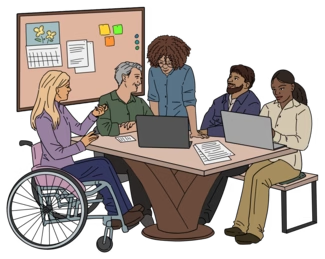
It is important to get good health information.
Health information should tell you
Here are questions you can ask to help you decide if you can trust health information.
Before you trust health information, it is a good idea to find out who made it and why.
Here are 2 questions you can ask to help you decide if you can trust health information.
Good health information comes from people and groups with good knowledge.
You can tell who made health information by looking at the:
You can usually find who made a health resource by looking at the front page, back page or the website or video description.
If you cannot find who made the information, it may not be good information.
In Australia, health information from the Australian government and state and territory governments is likely to be true.
Internet addresses that end in “.gov.au” are government websites.
For example, here are the internet addresses of two government websites:
Websites, facts sheets, books and other health resources that have government logos are also likely to be true.
The Raising Children Network website has the logo of the Department of Social Services with the words “supported by” above it.

This means that the Department helped pay for the website. The information on the Raising Children website is likely to be true.
Health information that comes from groups or people who are experts on the topic is likely to be true.
For example, GPs, psychologists and other health professionals are good sources of health information.
Good health information could be made by:
The resources made by Our Health Space are based on research and lived experience. The information in these resources is likely to be true. But you should always check if the information here is right for you.
Learn more about health information that is right for you.
Some health information is made to help you. It explains facts clearly. It helps you understand your health and know what to do.
Other health information may have a Information that has bias is unfair or one sided. For example, an ad might say that a drink has lots of vitamins. This can make the drink sound healthy, even if it also has lots of sugar. The ad has not lied but it has not told the whole truth either. Health information should:. Bias means that the information is unfair or one-sided.
For example, information might be biased if it is trying to sell a product. It might make you feel like you must buy the product to:
Avoid health information that has a bias.
Good information says:
This helps you decide how much to trust the information.
Learn how to tell if health information is up to date and based on facts.

Everyone needs health information that is good and meets their needs, but it can be hard to know what information you can trust.
One of the ways you can get health information is from health resources. Health resources can be things like:
Researchers asked people with intellectual disability, family members and health professionals what makes health resources good to use.
Together, they made a list to help people check health resources.
Resource Quality and If something is accessible, it means that everyone can use and understand something. For example: Accessibility makes things fair for people with a disability. Checklist for People with Intellectual Disability and Their Supporters
We have used ideas from the Checklist to write about how you can check if health information is good and right for you. In the links below, you will find examples and practical advice to help build your knowledge and skills.
Often, the best information comes from a person who knows a lot about health and knows things about you too. For example, GPs and other health professionals give good health advice.
The advice we give here should be helpful to most people, but it is not specific to you. Talk to a health professional if:
The National Centre of Excellence in Intellectual Disability Health (the Centre) works to improve health services and the health system so people with intellectual disability can live their best, healthiest lives.
The Centre was funded by the Australian Government. It is part of the National Roadmap for Improving the Health of People with Intellectual Disability.
Tell us about a helpful health resource that you want to share. It could be a podcast, checklist, tool, guide or something else. Resources can help people learn new things and find support.
Your feedback will help us improve Our Health Space.