Ask a question
You can ask questions or search for stories, guides, or tools that help you.

You can ask questions or search for stories, guides, or tools that help you.
The website remembers your choices on this device only. If you use another phone or computer, your settings will not be there.
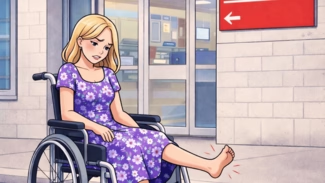
On Christmas Eve, I broke my ankle while leaving our local bowling club with my mother and father. There was a level change on the pathway that I didn’t see, and there was no lighting down the ramp. I knew straight away that something wasn’t right. I had a strong feeling I was going to end up in hospital.
We rang for an ambulance, but we were told the wait could be up to an hour, or that one might not come at all because it was Christmas Eve. We were lucky that family friends were with us and could drive me to the hospital.
We arrived at the hospital around 9:30pm. I went through Emergency and didn’t have to wait long, which I was grateful for. Even so, my body was in shock. I felt very cold, and my right ankle did not feel right at all. I was taken for x-rays quite quickly and then moved into a A treatment room is a hospital room or clinic where health professionals like doctors and nurses check you and give you care or medicine..
Advocacy is having your voice heard so your rights and needs are met.
An advocate is a person who speaks up to get you the support you need.
That was when my mum told the medical staff that I have a mild intellectual disability, which is a hidden disability. Having my mum there to Advocacy is having your voice heard so your rights and needs are met. An advocate is a person who speaks up to get you the support you need. for me was very important. Once staff knew about my disability, I noticed a change. They spoke more slowly, were calmer, and didn’t seem as rushed. I really believe it’s important for all health professionals not just doctors to know if someone has a hidden disability, because it changes how they communicate and support the patient. Patients have the right to understand what is happening and what is going to happen to them.
In a short amount of time, there were many doctors, nurses, and other staff coming in and out of the room. It was hard to keep track of who I had seen and what they had said. Even though staff were calmer, they still used a lot of medical language that wasn’t easy to understand. I had a basic idea of what was happening, but when I was told I needed surgery to fix my ankle, I panicked. That’s when I realised, I needed to take everything one step at a time.
Because I was still in shock, Emergency wasn’t the best place or time for me to process information. Staff were focused on getting my ankle back into place and getting me on the A plan that shows the names of people who are having surgery that day and the order they are in. . They told us that my ankle was badly broken, but they didn’t explain the x-rays very well or how the break had happened. I understand it was Christmas Eve and very busy, but even showing the x-rays on a bigger screen, like an iPad instead of a phone, would have helped me understand better.
I was When someone is admitted to hospital, it means they are coming in to stay there for care and get treatment from health professionals like doctors and nurses. Sometimes called a Community Assessment Unit (CAU), this is a place in a hospital where health workers check and support people with long-term or complex health problems. to hospital but didn’t get a room until about 2:30am on Christmas morning. We were placed in a quiet , and the nurses there were very helpful. I was put on the surgery list for Christmas Day, which meant I had to fast from midnight on Christmas Eve. When the doctors finished early and my surgery was moved to the next day, I had to fast again from midnight on Christmas Day.
Early on Boxing Day morning, it felt like my foot moved out of place and I was in a lot more pain. A lovely A doctor that you see when you need a health check came in to talk about pain relief options. Most pain relief was in tablet form, but I can’t swallow tablets. We decided on a morphine injection into my stomach, which helped for a few hours.
I felt upset and frustrated about pain management. Because I was on the community ward, they wouldn’t give medication through my A cannula is a small plastic tube put into a vein, usually in your hand or arm, so you can get medicine or fluids. and kept saying they “didn’t have the tools.” For someone who can’t take tablets and needs liquid or alternative medication, there should have been more compromise or planning.
By Boxing Day, I was in so much pain that I just wanted the surgery done. When it was time to go to the operating theatre, I was in too much pain to be moved and said no to being transferred to the operating bed unless I was put to sleep first. It took some convincing, but once I got to theatre, staff listened. I don’t go under or come out of Anaesthetic is a medicine that stops you from feeling pain. It is often used during surgery or medical treatment. very well and need higher doses, so being listened to really mattered. My mum pushed for staff to allow her to stay with me as much as possible and having her there the whole time made a huge difference, especially when I was emotional and overwhelmed.
After surgery, I stayed in hospital for two more days learning how to move around on one foot. The The orthopaedic ward is a place in the hospital people who have problems with their bones and joints or muscles like a broken leg. felt very different to the community ward. It was noisier and busier, and nurses took longer to respond to the call bell. I understand this was likely because it was Christmas and staff were short-staffed, but it still affected how supported I felt.
When I was discharged, we were given information about what to look out for and what to do at home. I understood some of it, but my parents listened more closely than I did. Even now, because of the time of year, we still haven’t seen the surgeon.
Looking back, the most important things I learned are how vital advocacy and communication are. Having someone you know and trust to speak up for you makes a huge difference. There needs to be better handover between staff when a patient moves from one ward to another. important information, like having a hidden disability, should not get lost.
I think hospitals should have a clear system to flag hidden disabilities when someone first comes through emergency. For example, a simple sticker or marker on the file. So staff know straight away and can adjust how they communicate.
If I could say one thing to all medical staff, it would be this: slow down and use easy-to-understand language, even if that’s hard when you’re used to medical terms. Also, let patients know how many people are in the room and what their roles are, especially if the patient feels overwhelmed by too many people at once.
Clear communication, patience, and respect can make a frightening hospital experience much safer and more understandable for people with hidden disabilities.
I work for the National Centre of Excellence in Intellectual Disability as a lived experience project worker.
Help others learn and feel connected by telling your story here. You can write or record it. You can get help telling your story if you need it.